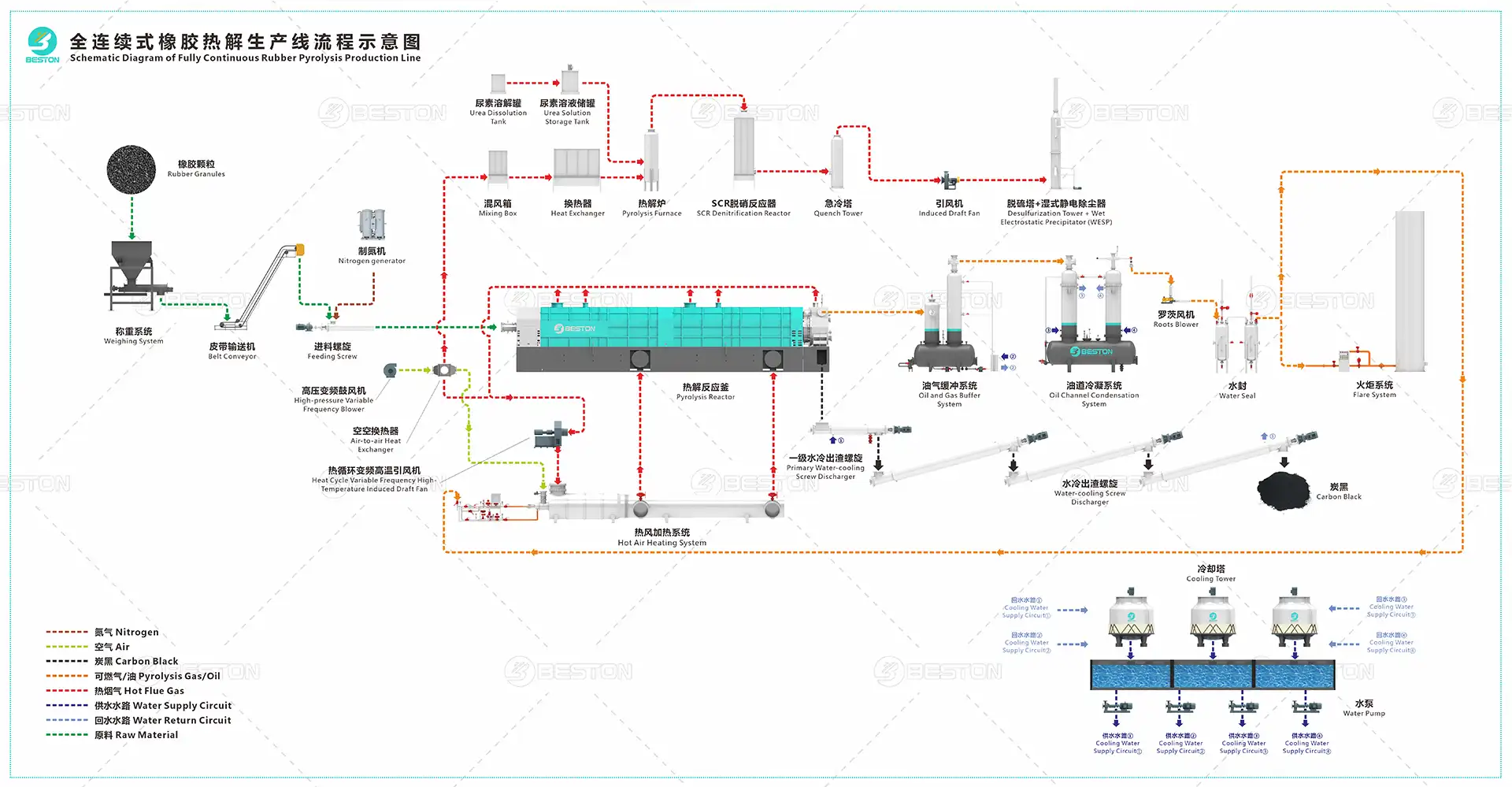
Continuous tyre pyrolysis plant offers a highly efficient and scalable solution for converting waste tyres into valuable resources such as fuel oil and recovered carbon black. Compared with traditional batch systems, continuous pyrolysis technology provides higher automation, lower operating costs, and more stable product quality. As global demand for sustainable recycling solutions continues to rise, continuous waste tyre pyrolysis plant is becoming an attractive option for investors seeking long-term profitability and environmental compliance. This article provides a clear overview of its working process, product value, and the key factors to consider before making an investment.
| Model | BLL-30 |
| Manufacturer | BESTON |
| Time to Market | 2025 |
| Motor Brand | Chinese brand |
| Suitable Raw Materials | Waste plastics; Tires; Oil sludge |
| Input Capacity (Max.) | Waste plastic pellets: 0.8-1.05t/h Rubber powder: 1.25-1.5t/h Oil sludge:1.8-2.3t/h |
| Working Method | Fully Continuous |
| Final Oil Quality | Pyrolysis oil Pyrolysis oil with wax or naphtha |
| Reactor Materil | 304/310S Stainless steel |
| Reactor Life Span (Years) | 5-8 |
| Guarantee (Months) | 12 |
| Delivery Time (Calendar Days) | 60-90 |
| Land Space Required (L*W*H*m) | 70*20*10 |
| Packing | 20*6*3m in bulk+13*40HQ |
| Installation Period (Calendar Days) | 90 |
| Packing | 20*6*3m in bulk+13*40HQ |
| Installation Period (Calendar Days) | 60-90 |
30 Days Continuous Operation
Oil-gas direct spray mixing condensation technology achieves rapid cooling. Furthermore, this design prevents secondary polymerization of olefin compounds from clogging the oil gas pipelines. This avoids frequent downtime for maintenance, providing a solid guarantee for the entire line to achieve continuous and stable operation for 30 days.
55% ↓ Fuel Use, 50% ↓ Emissions
BLL-30 continuous tyre pyrolysis plant reintroduces 80% of high-temperature flue gas into the combustion chamber. It mixes evenly with hot air from the burner and then heats the reactor. The remaining 20% of high-temperature flue gas heats fresh combustion air, which supplies oxygen to the furnace. Together, these two methods cut energy consumption by 55% and reduce emissions by 50%.
80% ↓ Manual Work
The combustion system uses a multi-medium automatic burner valve assembly. Combined with hot-air heating, this design automatically adjusts the fuel mix to suit different fuels, achieving temperature control accuracy of ±10℃. With continuous feeding and discharging, only two operators are required for BLL-30 continuous waste tyre pyrolysis plant, reducing manual intervention by 80%.
Recovered Carbon Black (rCB) is a high-value product transformed from the initial carbon black in tires through grinding and granulation processes. It has a higher specific surface area and better particle size distribution, making it suitable for various high-end applications.
Tyre Pyrolysis Oil (TPO) is a high-value byproduct generated from tire pyrolysis plant. It can be used directly as fuel or further processed into diesel and naphtha.
The key advantages of BLL-30 continuous tyre pyrolysis plant is simultaneous feeding and discharging. Compared to traditional batch pyrolysis, the continuous process efficiently and automatically collects oil, carbon black, and gas, eliminating the interruptions and repetitive operations of batch processing.
The continuous pyrolysis process produces carbon black (rCB) of higher quality than batch processes, particularly in the key indicators of Toluene Permeability and Total Petroleum Hydrocarbon (TPH).
Unlike whole tyres for batch system, continuous waste tire pyrolysis plant adopts tyre rubber powder. Finer powder provides larger surface area, ensuring more even heat distribution. Thus, it improves thoroughness of pyrolysis process.
The quality of materials, manufacturing processes, and structural design directly affects the stability and lifespan of a continuous waste tire pyrolysis plant. Durable and heat-resistant equipment reduces maintenance frequency and lowers operational risks.
Investors should evaluate pyrolysis plant cost, inclduing equipment cost, installation expenses, operating costs, and local market demand for pyrolysis products . A clear return-on-investment assessment is essential for ensuring project feasibility.
Continuous pyrolysis systems are technologically complex and require reliable technical support. Installation guidance, operator training, and spare parts supply help maintain stable plant operation and minimize downtime losses.
Pyrolysis projects must meet local environmental and safety standards. Efficient exhaust-gas treatment systems—such as cooling, dust removal, and desulfurization—are vital for regulatory approval and long-term compliant operation.
From Quality to Compliance, Beston Group Supports Your Project Step-By-Step.
Continuous tyre pyrolysis plant plays a vital role in the sustainable development of energy and manufacturing. This technology minimizes environmental impact while reducing reliance on traditional fossil resources. It supports a circular economy model, thereby improving industrial efficiency and promoting long-term ecological balance. As industries worldwide accelerate their transition to cleaner production and responsible energy use, adopting continuous pyrolysis solutions is not only an economic choice but also an environmental commitment. For more industry insights and the latest developments in sustainable technology, please follow our LinkedIn page.